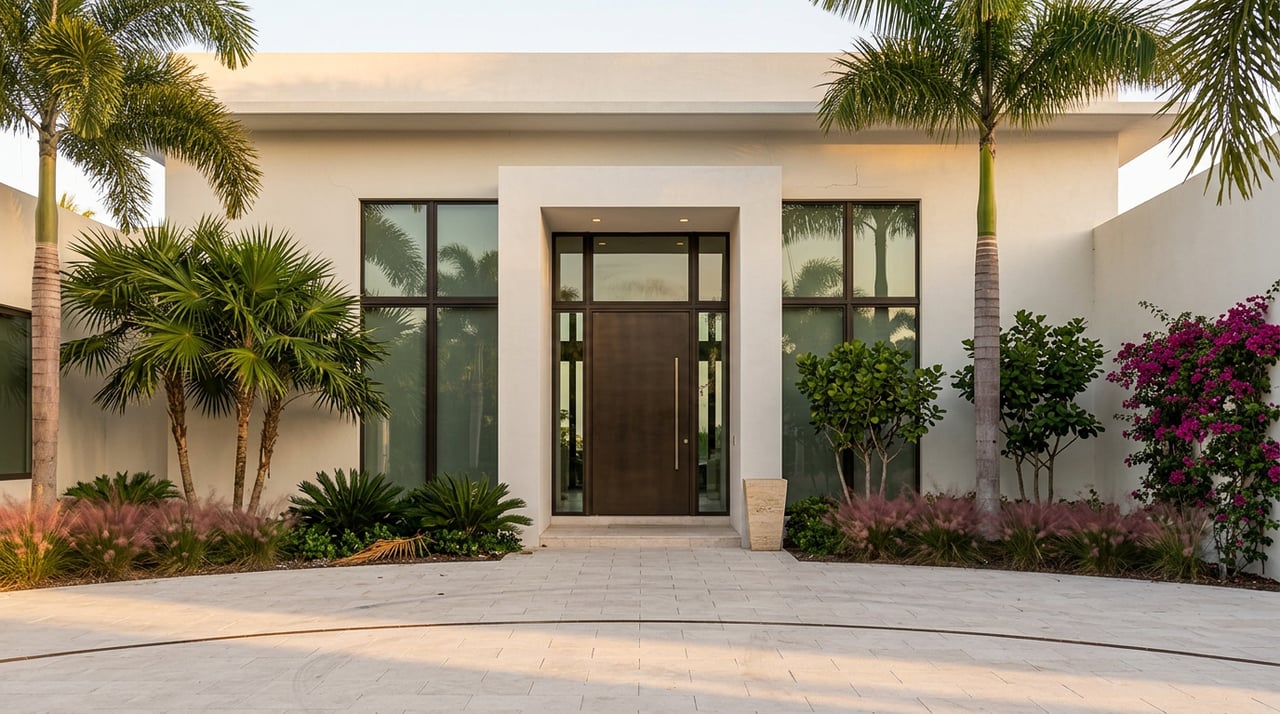
Two Port Royal lots sit three doors apart on the same canal. Both offer no-bridge Gulf access. Both were built in the last decade by named local architects. One recently traded at a number the other could not touch, and the delta had almost nothing to do with the house.
It had to do with a deeded status attached to the parcel: whether the buyer, within 90 days of closing, could walk into the Port Royal Club membership office and enroll.
That single line item is the mechanism most out-of-market buyers underestimate. In a neighborhood where median closed prices ran to $19 million in January 2026 and price per square foot climbed 41.4% year over year to $3,719, the assumption is that water frontage or new construction explains the gap between comparable properties. Often it does not. Club eligibility does.
The mechanism hiding in plain sight
Port Royal Club membership is not open to the neighborhood at large. It is tied to specific properties through a Resident Membership eligibility status that either exists at closing or does not. According to the Port Royal Club, within 90 days of purchasing an eligible property, a new owner may become a full member, place a deposit equal to 25% of the current initiation fee plus 25% of annual dues to hold the property's eligibility for up to four years, or elect neither, which suspends the property's status entirely and triggers a reinstatement fee equal to 75% of the current initiation fee.
The Club has been the social spine of the neighborhood since 1959, offering private beachfront dining, a beachfront pool, Har-Tru tennis courts, fitness, and spa facilities on a stretch of Gulf sand no non-member can access. Ownership without eligibility means owning in Port Royal without the amenity most buyers picture when they picture Port Royal.
The pricing consequence is measurable. Homes with confirmed full Club eligibility typically command a 15% to 20% premium over non-eligible properties in the same neighborhood, and one 24-month analysis of the local market found Club-eligible homes averaging $18.9 million in sale price, roughly 128% above associate-level properties. The premium is not a soft lifestyle argument. It shows up in every comparative market analysis.
The 90-day clock most buyers do not see
This is where the transaction friction sits, and it is worth understanding before an offer is written rather than after a closing statement is signed.
| Decision within 90 days of closing | Financial mechanic |
|---|---|
| Enroll as full Member | Pay current initiation fee plus annual dues |
| Defer enrollment, retain eligibility up to 4 years | Deposit 25% of initiation fee, pay 25% of annual dues each year |
| Take no action | Property's eligibility is suspended; reinstatement costs 75% of the current initiation fee |
The initiation fee itself is a moving number. It stood at $315,000 through 2025 and rose to $400,000 on January 1, 2026. Annual dues are $16,200. A buyer who closes without a plan for the 90-day window is not choosing between amenities. They are choosing between paying today's fee, warehousing 25% of it, or paying 75% of it later to recover a status their neighbors take for granted.
There is a second layer of specificity buyers miss. Not every "eligible" property carries the same status. Some lots hold immediate Resident Membership eligibility. Others carry only associate-level rights. The difference is deeded, verifiable in the property record, and best confirmed before the offer, not during due diligence. A listing that reads as Port Royal Club adjacent is not the same as one that is Club-eligible, and the two words at the end of a listing description can move the price by seven figures.
Why the premium is about to widen
Hurricane Ian's September 2022 storm surge left the original 1959 clubhouse beyond meaningful repair. Rather than restore, the membership approved a $100 million ground-up rebuild: a 62,000-square-foot beachfront clubhouse designed by Hart Howerton with interiors by Champalimaud Design, built by Suffolk Construction. Completion is targeted for late 2026.
Between the storm and the reopening, some buyers read the temporary closure as a discount signal. Local market data suggests the opposite happened. Port Royal's Jan 2026 numbers, drawn from Southwest Florida MLS reporting, show dollar volume more than doubling to $696.3 million on the corridor covering Port Royal to Bonita Beach Road, average sale price climbing to $24 million, and inventory contracting from a 2024 peak of 44 available homes to 29. Pending sales rose 47.4%. Months of supply compressed from 25.26 to 11.60.
That is a market pricing in the reopening, not waiting for it. Analysts covering the local luxury tier project an additional 5% to 10% premium on Club-eligible properties once the new facility opens, layered on top of the existing 15% to 20%. For a buyer sitting on the fence into early 2026, the fee schedule and the amenity delivery timeline are moving in the same direction.
The buyer who closes on a Club-eligible property before the new clubhouse opens is buying the premium at today's price. The buyer who waits is buying the same premium after it has been re-rated.
What the market data actually says once you filter for eligibility
Portal-level Port Royal data reads as a single market. It is not. It is at least three.
The William Raveis Luxury Market Report for the 12 months ending April 30, 2026 recorded 22 Port Royal single-family closings at an average price of $21,264,773, with inventory down 31% to 25 units. That average includes non-eligible properties, tear-downs sold for land value, and Club-eligible estates trading at institutional prices. A recent $40 million sale at 860 Admiralty Parade E., reported by the Business Observer in April 2026, closed on an 11,500-square-foot house completed in 2024 with 177 feet of frontage. The prior owners had paid $10.5 million for the same address in 2020. Some of that appreciation is the house. Some of it is the parcel's status.
Days on market tell a similar layered story. Portal aggregators report Port Royal homes sitting a median of 181 to 212 days before contract, well above the Naples average. That number flattens two different behaviors. Non-eligible properties and mispriced eligible properties absorb the long tail. Correctly priced, confirmed-eligible estates transact faster and often quietly, which is why the reported price per square foot in January 2026 sat at $3,100 to $3,719, the highest in Naples, even as the average days-on-market number suggested a slow market.
The takeaway for a buyer comparing Port Royal against Aqualane Shores or Old Naples on a portal spreadsheet: the median is not the number to compare. The eligibility-adjusted median is.
FAQ
Can eligibility be added to a non-eligible property after purchase? No. Eligibility is tied to the deeded rights of specific properties. It cannot be conferred by renovation, rebuilding, or lot combination. This is why verification before offer matters more here than in most Naples neighborhoods.
What happens if a property's eligibility has already been suspended by a prior owner? The reinstatement fee is 75% of the current initiation fee, which at 2026 rates means $300,000 on top of the standard membership costs. That figure travels with the property. A buyer taking on a suspended lot is inheriting that liability whether the listing highlights it or not.
Does the 90-day window pause for renovations or extended out-of-country closings? The window runs from purchase, not from occupancy. Buyers planning a long renovation before moving in still need to make the enrollment, deposit, or suspension decision inside that 90-day period. The deposit route exists precisely for buyers who want to hold the status without committing to full membership immediately.
How does the initiation fee compare to other private clubs in the area? Naples supports several private beach and golf clubs at different price points, but no other Naples club combines deeded property-linked eligibility with a $100 million new-build beachfront facility of this scale. Comparisons on initiation fee alone miss what the fee is actually buying.
Working through a Port Royal offer
The Port Royal transaction is not a square-footage exercise. It is an eligibility exercise wrapped inside a real estate contract, and the buyers who overpay tend to be the ones who did not confirm the deeded status of the lot before they wrote the number. The sellers who leave money on the table tend to be the ones who did not document that status clearly in the listing package.
Both sides of the table benefit from working with an advisor who reads the eligibility record alongside the survey, the flood elevation, and the comparables. If you are evaluating a purchase or preparing to bring a Port Royal property to market ahead of the clubhouse opening, John Shirey is available for a direct, confidential conversation.
Let's Connect.